
Doubles guide
HYROX doubles, explained: who runs, who works, and what counts
Doubles is the same race as singles, run by two people who share the work. The rules are short. The strategy is where it gets interesting.
The race itself
A HYROX is eight runs of one kilometre, each followed by a station: SkiErg, sled push, sled pull, burpee broad jumps, rowing, farmers carry, sandbag lunges and wall balls, in that order. In doubles both of you race the whole thing, from the first run to the finish line, and one time counts for the pair.
Who runs
Both partners. Every one of the eight kilometres is run by both of you, together, and you have to stay together. The run is not where you gain time by being clever, it is where you keep the pair moving.
Who works
At the stations, only one of you works at a time. The other waits in the marked zone until you swap. How you split a station is up to you: one partner can do all of it, or you can swap as often as you like. The volume is the same as singles, so on the wall balls, for example, the pair does 100 reps in total, not 100 each.
That freedom is the whole point of doubles. A good pair does not split everything 50/50. It puts each partner where they are strongest and swaps before either one slows down.
What counts
Both of you cross the finish line, and the clock stops for the pair. Judges watch the same things as in singles: full range on the lunges and burpees, the ball hitting the target, the sled crossing the line. Both of you working at once on a station, or running apart, costs a penalty or a no-rep, so agree the swaps before the start.
The weights depend on your division: Doubles Women, Doubles Men, Doubles Mixed, and the Pro versions of Women and Men. Mixed has a single weight class for the pair. The full table is in our weights by division.
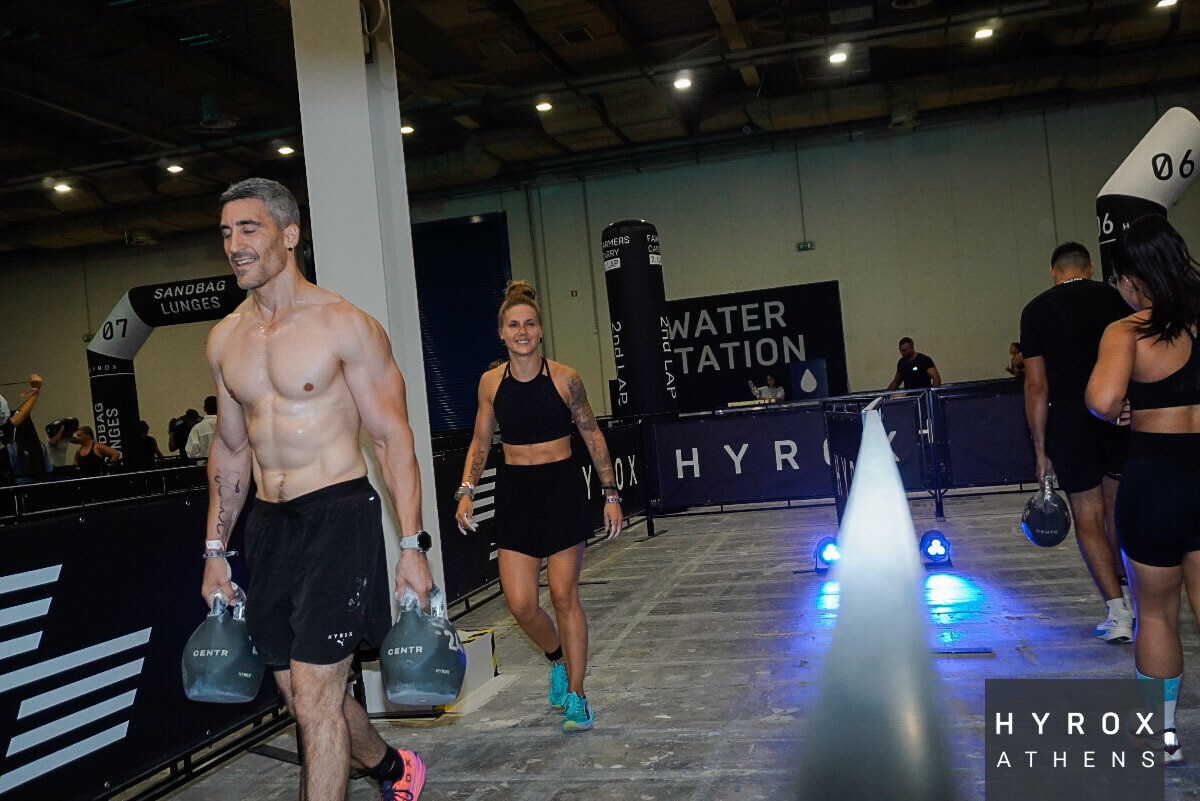
We split the stations mostly based on strengths, not 50/50 for the sake of it. I'm stronger on the heavier, more power-based stuff, so it made sense for me to take more there. Fabienne is ridiculously strong for her size, especially upper body, so the whole idea was to use both of us where it actually made sense instead of trying to make everything perfectly equal. We did swap during some stations rather than having one person do the whole thing. The one thing I'd change next time is deciding even more clearly beforehand where the swaps happen, because during a race even five seconds of "you? me?" is stupidly expensive.
Emi, after HYROX Athens 2026, Doubles Mixed, 1:27:00 with Fabienne
Before you race
Write the split down. Station by station, who starts, where you swap, who finishes. Then train it at least once so the handovers are automatic. And read the current rulebook the week before: distances and weights change between seasons, and the judges apply this season's version, not last year's.


Questions athletes ask
Do both partners have to run every kilometre?
Yes. All eight runs are done by both of you, together. Only the stations are split.
Can one partner do a whole station alone?
Yes. The split is entirely up to you, from one partner doing everything to swapping every few reps.
Is the volume halved in doubles?
No. The station volume is the same as singles, shared between two people. Wall balls are 100 reps for the pair.
What if we don't have a partner yet?
That is what ROXMATCH is for: athletes racing the same event, in your division, chasing the same time.